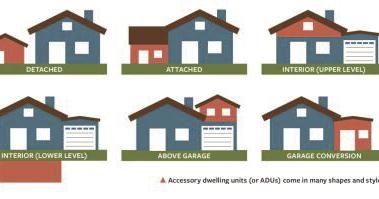
The Edina City Council unanimously approved an ordinance to allow accessory dwelling units (ADUs) to be built on plots with single-family homes.
Before the vote April 16, Community Development Coordinator Addison Lewis discussed how existing city regulations would impact the development of ADUs. He pointed to Edina’s tree protection ordinance, which may deter property owners from removing trees to construct a detached unit; impervious surface requirements and building coverage limits.
In Edina, lots that are 9,000 square feet or greater in area cannot have more than 25% of the lot be occupied by principal and accessory buildings. Lots under 9,000 square feet have a limit of 30%, but not more than 2,250 square feet.
“It’s important to note that this ADU ordinance does not allow you to cover any more of your property with a building than is currently allowed today,” he said. “So even though the maximum size allowed for an ADU may be 1,000 square feet, that’s simply not going to be possible for a lot of properties.”
After bringing up concerns about how neighbors could be affected by ADUs at a public hearing, Councilmember James Pierce discussed potential mitigation measures with Lewis and Planning Commissioners Quincy Smith and Jimmy Bennett.
Some ideas that came out of that conversation include encouraging the owner building the ADU to connect with their neighbors, keeping the ordinance on the work plan and considering changes after a few years where there is data to analyze.
Pierce also brought up looking at providing neighbors an opportunity to apply for privacy screening variances. Current city code has a max fencing height of six feet for side and rear yards. Pierce suggested that residents could apply for fencing up to eight feet tall.
“We’ve got to really be thinking about what changes do we need to make in order to make sure that we’re making policy and building code decisions that’s representative of everybody in Edina – and not just predominantly focused on something that an owner of a property might be trying to do because the neighbor who feels an imposition is a property owner too,” Pierce said. “We should be able to provide some methods that that owner, should they want to mitigate a potential imposition, they have some options. And today, I think those options are limited.”
Councilmember Julie Risser also brought up the importance of maintaining privacy in growing neighborhoods. She asked if there could be language included in the ordinance that would limit window sizes and have balconies facing the primary property instead of a neighbor’s yard.
Agreeing with Risser’s concerns, Mayor James Hovland suggested a team could create design element guidelines for ADUs, similar to the city’s Greater Southdale Area District Design Experience Guidelines. He added that these guidelines could be incorporated into an ordinance down the road.
Councilmember Kate Agnew said ADUs present many applications and uses for residents, which was one of her reasons for supporting the ordinance.
“When I think about the importance of opening up opportunities for housing, giving people more options and really just making different forms of housing more accessible, I think that that’s just really advancing us as a community,” Agnew said.