
This article was originally published by Sightline Institute.
The Maine family needed a cheaper place for one of them to live. And quickly.
It was 2024. Synia Maine, 56, had just developed a back injury so severe that she had to retire from her career as a hairstylist a decade earlier than planned. Suddenly, she had increased medical bills and no income.
Her daughter-in-law, Ember DeVaul, recounted that they’d explored multiple options to try to keep Synia in Arizona, where she lived. Even the lowest-cost housing option, manufactured homes, required a permanent foundation and tens of thousands of dollars in permitting costs.
Ember and her husband, who live in East Portland, looked into converting their own garage into housing. Only one contractor bothered to reply to them after they stated their budget was just $100,000. The verdict? It would take $150,000 minimum to convert the garage, but the resale value of the property would only increase by half that amount. Another issue was the estimated six months to get through design and permitting. “We didn’t have time to wait,” Ember said. Because Synia was an independent contractor, she didn’t have health insurance, and she had used up her savings just to keep up with the bills. “It’s crazy how fast everything can change,” Ember said.
Kol Peterson, the sole contractor who showed up at Ember’s home, proposed another idea: a tiny home on wheels.
A fast solution for a family in crisis
Unlike a traditional backyard cottage, tiny homes on wheels and recreational vehicles (RVs) are legally considered vehicles. This means that they aren’t subject to the building permit process and its associated fees. All that the city requires is an additional utility connection, or access to the main house if the external dwelling doesn’t have internal plumbing.
“It ended up being realistically our only option,” said Ember, “other than her being homeless, really.”
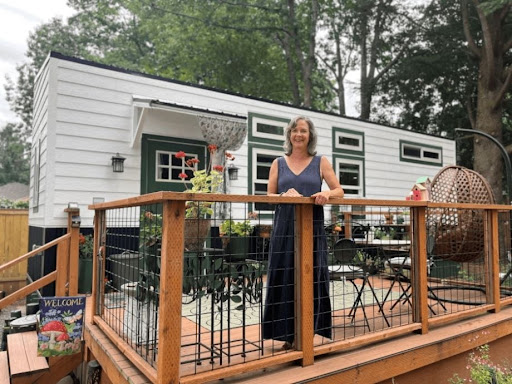
Synia ended up settling on a park model RV, which is larger and designed as a long-term residence rather than for cross-country voyages. Even with upgrades like four-season insulation and a 35-year warranty on the roof, the total cost came to $104,000. Adding the water and sewer connection only cost another $5,000.
The new home is being delivered in mid-September. Though it’s intended to be permanent, the fact that it could move elsewhere in the future made everyone more comfortable. “She is just so scared of being a burden,” Ember recalled. “If she doesn’t want to live with us anymore, she can take it somewhere else and not feel indebted to us.”
Tiny homes on wheels: A Portland success story
Synia is lucky that her son and daughter-in-law moved to Portland five years ago. It’s possibly the only city in the United States that has fully legalized living in wheeled dwellings on residential lots instead of just within commercial RV parks. In both of the Arizona cities where Synia’s other daughters live, Synia’s new living arrangement would be illegal, as it is in the vast majority of North American jurisdictions.
Portland first started creating a legal pathway to this low-cost shelter option in 2017, after Luz Gomez, an immigrant from Honduras, brought a spotlight to the issue alongside the Leaven Community, a faith group in NE Portland she was involved with. At the time it was estimated that at least 100 of these homes already existed illegally, and their residents could lose their homes if neighbors reported them. City Commissioner Eudaly, elected to city council as a housing advocate, directed the Bureau of Development Services to stop enforcing prohibitions against them in 2017. Four years later, Portland passed an ordinance fully legalizing tiny homes on wheels and RVs as permanent housing options on residential lots with an existing home.
Because so little paperwork is required, there is no official count of how many Portlanders live in homes on wheels. But it’s likely more common than people realize. Peterson, the contractor who worked on Synia’s project, counted more tiny homes on wheels and occupied RVs in his neighborhood than traditional ADUs on foundations back in 2020. In other words, this was a fairly common way for people to live even before it was formally legalized and regulated.
Since the city began legalizing and lightly regulating them in 2021, Peterson’s company Tiny Hookups estimates it has installed sewer hookups for roughly 40 more. Tiny Hookups regularly gets job requests from outside of the city of Portland, but it always declines to get involved. It’s still illegal.
But for people seeking stable, private shelter in Portland, the price is impossible to beat. All of the people interviewed for this story financed their new homes with income from a home sale or personal savings. Even if you took out a loan for a brand new $100,000 RV (at nine percent interest for 20 years), that would equate to a payment of just $900 per month. In affordable housing speak, that’s low enough for a person making roughly $35,000 per year—40 percent of the median income (AMI) for the Portland area—to comfortably afford.
Costs can certainly go down from there. Craigslist has multiple used tiny homes for sale in the $30,000–$50,000 range, and older RVs in the $5,000–$10,000 range. For the nearly 1 in 8 Portland area households in need of deeply affordable housing, defined as affordable to people at the 30 percent AMI level or less, these dwellings offer a solution without years-long waitlists, housing lotteries, or public subsidy.
Because tiny homes on wheels are classified as vehicles instead of buildings, they get the benefits of bypassing much of the red tape and fees required for a backyard cottage. The largest infrastructure expense—an additional hookup for sewer, water, and electricity—can range from $3,000 on the low end to $15,000 for a complicated property. Scheduling city inspectors to certify the work can happen in a matter of weeks. If the vehicle doesn’t have internal plumbing, that’s allowed, too, as long as occupants have electricity and access to a bathroom in the main house.
Portland does not require any inspections on the mobile dwellings themselves—a critical part of making the program work, according to Peterson. If they had been subject to the same requirements as an ADU or a certified park model RV, as originally proposed, many existing residences wouldn’t have qualified. Standard RVs, the most affordable housing option, are built to different ANSI standards than park model RVs. Inspecting an already-built tiny home would require stripping it back down to the pipes and wires, a task few owners would volunteer for.
Vehicles like RVs do have be operable with wheels still attached, though they aren’t required to maintain an active registration with the Department of Motor Vehicles. City code already prohibits inoperable vehicles from being visibly stored on private property for longer than 7 days. Since the dwelling is not permanently affixed to the property, it does not count toward a site’s limit of how many homes can be built per local zoning. As long as there is space available, homeowners always have the option of adding a home on wheels.
The simplicity of purchasing and installing a home on wheels compared to a backyard cottage has made it the ideal option for lots of Portland families, not just the Maines. Below are two more stories on why people are choosing mobile dwellings.
A grandma-friendly solution for backyard childcare
When Peggy’s granddaughter Nora was born in March 2021, living in tiny homes still was technically illegal in Portland. Peggy decided to do it anyway. “I talked to a bunch of different departments,” she said. “They all pretty much said ‘you know, we’re not citing, but if you throw loud parties and neighbors complain, we’ll have to come out.’ But they all knew that eventually [the legalization proposal] would be voted in.”
Peggy, who lived in California at the time, wanted to be closer to her daughter in Portland to pitch in on childcare, just like her mother had done for her decades earlier. And size wasn’t an issue: she had already made the move from a 3,600-square-foot house to a 1,000-square-foot condo and felt confident she could go smaller.
Her 311-square-foot tiny home was initially supposed to be done in June of 2021, but COVID-related delays pushed the delivery date to December. In the interim, Portland’s city council adopted the ordinance legalizing it. “I was actually lucky that it was passed before my tiny house came. It’s nice to do things legally,” said Peggy. She has now been living in the backyard of her daughter’s home for three-and-a-half years. “I love it.”
The home itself cost her $91,000, and then another $7,000 for the utility hookups and a gravel pad to park the house on. One of the biggest decisions to make was about the toilet and the associated sewer line. Due to a large tree, they had to use a directional boring machine to connect the sewer pipe, which made the hookup more complicated. “They were like, ‘Do you really want a flushing toilet?’ And this is me: ‘Yes, yes I do!’” Peggy recounted with a laugh. “If I lived in the middle of nowhere, then I’d be like, ‘No, I can do composting or incinerating,’ but the incinerating toilets are like $9,000.”
She has made other upgrades since she moved in. Her first winter in Portland, she constantly felt chilled, so she had more heaters installed and a skirt that wrapped around the bottom of the house to stop cold air from passing under the floors. Currently she is in the process of repainting the exterior, to try to stay ahead of the local moss that can grow in any crevice.
The tiny home has furnished Peggy with plenty of advantages. Peggy watches Nora three days a week while enjoying her own separate space to return to each evening. If Peggy’s daughter decides to move to another house in the future, Peggy can go with them or move into a tiny home community. And not having a mortgage also allows her more flexibility to travel. This fall, Peggy has a three-week trip planned that will have her visiting Amsterdam, Kenya, and Tanzania.
A solution for tree preservation and small yards
Another big advantage of tiny, portable homes: they fit.
On some properties, restrictions on where a new building can be placed—five or ten feet back from property lines, separate from adjacent buildings, out of trees’ protected root zones—can result in no buildable area at all. That would have been the case for Teresa Farrell’s home. According to homebuilder Kol Peterson, an ADU on her property would have been “totally impossible.”
It happens all the time, according to Peterson. “I’d walk into a site like that to do an ADU consult for a family that truly needs an ADU, and in five minutes, the homeowner’s dreams would be smashed. Whereas with a tiny home on wheels, it’s no problem. It’s a snap,” he said.
To add a conventional ADU with a foundation, the large evergreen gracing the photo below would need to be cut down. Cutting through roots so close to the tree would undermine its health and create a future safety hazard. With a tiny home on wheels, however, a new home can perch atop the yard, leaving the roots and tree intact.
Yard geometry wasn’t the only issue, though. “The expense was crazy,” Farrell recounted. “It was going to be $300,000 to build an ADU. No way.” The tiny house they found cost just $79,000, including delivery from California. The utility hookups were another $13,000, since the water main was on the other side of the house.
Farrell isn’t exactly sure who her future tenant might be. She’s hoping her close friend Marilyn might move in. Now in her 80s, Marilyn currently lives alone in a huge house that is getting harder to take care of. “She has friends in the neighborhood, so it would be perfect,” Farrell said.
Another possibility might be the Farrells’ daughter, who is currently living in Eugene. Since moving from their larger house in Sellwood, they no longer have a bedroom for her when she comes to visit. Or if she someday moved back to Portland, it could be an affordable but still private home for her to enjoy. “Affording rent is really, really hard for people her age,” Farrell said. “I don’t know how she’ll ever be able to buy a house.”
A third option would be to house a future caretaker. “I’m a little bit worried about my husband,” she shared. Aged 76, he’s starting to have issues with his memory. Farrell kept having a nagging sensation that it was time to make extra space and get things in line for the next stage of life.
Farrell’s ability to create space for any of those people was only possible because Portland legalized mobile dwellings as a housing option. For others like Synia and Peggy, homes on wheels allowed them to live near family, retain independence, and cut housing costs beyond what a traditional ADU could offer.
“I’m so lucky,” said Ember, reflecting on the situation with her mother-in-law. “I feel very thankful that we live in Portland, and that this was the situation we could do.”
Other jurisdictions looking for fast, affordable solutions to the housing shortage might consider following Portland’s lead. The low price tag and flexibility of a home on wheels is impossible to beat—which is why many people already live in them, legal or not. The regulatory framework Portland adopted simplified the process and reduced risk for everyone involved, making this living arrangement viable for more families who need it.
Whether these dwellings ultimately end up housing a family member, caretaker, or other neighbor, homes on wheels are a vital piece of the housing puzzle that residents of any city could put to use right away.
Catie Gould is a storyteller, researcher, and advocate for parking reform whose work helped win groundbreaking parking reforms in Oregon, Anchorage, Montana, and Washington state. Contributing to these wins were her numerous local stories spotlighting small businesses and homebuilding efforts harmed by parking mandates; her cataloguing dozens of cities’ arcane parking rules in a report for lawmakers and advocates; her compelling testimony in public hearings; and her reliable aid to legislative champions as a policy expert. She is a senior researcher with Sightline Institute and a contributor to the forthcoming book The Shoup Doctrine, honoring the life and legacy of Dr. Donald Shoup. Learn more about Catie’s work at sightline.org/parking.