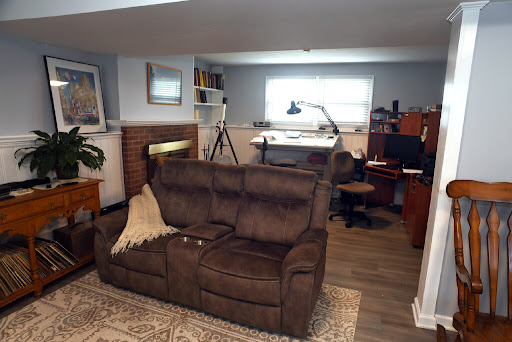
An accessory dwelling unit in Milford, Conn., in 2022.
Ned Gerard/Hearst Connecticut Media
One of the most flexible and affordable housing types is the humble accessory dwelling unit, or ADU. Also known as backyard cottages or granny flats, these classic American housing types are either illegal or impractical to build across much of Connecticut — but that could soon change. HB 5507 (An Act Promoting the Development of Accessory Dwelling Units) is a common-sense bill to re-legalize these classic American homes. ADU’s are right for our towns and for Connecticut, and the General Assembly should unlock housing flexibility for the state.
Accessory dwelling units are smaller, secondary housing units on a single-family residential lot. They can be attached (like a converted garage or basement) or detached (like a small structure in the backyard). ADUs are as American as apple pie. Think of the Cunninghams renting a room above their garage to Fonzie in “Happy Days,” providing a home for the Fonz and extra income. Or think of Danny Tanner’s friend Joey living above his garage or his brother-in-law Jesse living in his converted attic to help him raise his three daughters in “Full House.” Or closer to home, think of Lorelei and Rory having some privacy and independence in their converted backyard cottage in “Gilmore Girls.”
But ADUs aren’t just for fictional characters. Life is complex, and real families benefit from the flexibility offered by ADUs. I am friendly with a senior in Trumbull who owns a single family home that is increasingly outsized and expensive to maintain. He is looking for social connection and is increasingly interested in co-living arrangements, and an ADU in town would offer him an affordable way to remain near friends while living in proximity to others.
Another example comes from one of my colleagues, who has a child with disabilities. She and her husband want to explore building a backyard cottage so their child could maintain a level of independence while also being cared for. Closer to home, my parents are looking to downsize, and a future where I can more easily build a backyard ADU could help them keep their independence while staying a connected part of my life.
Those are the personal stories, but let’s consider two towns that would benefit from better ADU policy: Trumbull and Wallingford. Even in an affluent town such as Trumbull, there are residents who could use more affordable housing options. The nonprofit Data Haven found that 30% of Trumbull’s residents are housing cost burdened, meaning they spend at least 30% of their total income on housing costs. Similarly, the United Way of Coastal and Western Connecticut discovered 23% of Trumbull residents are what they term “ALICE families,” meaning they are “Asset Limited, Income Constrained, Employed.”
Not only do ADUs fill a need for Trumbull’s residents, they’re also popular. Trumbull’s 2023 Affordable Housing Plan found that the town had “a lack of diversity of housing types” and that “older residents seeking to down-size might be forced to leave town due to a dearth of appropriate housing stock.” And a strong plurality of Trumbull residents responded that ADUs are a good way to meet those housing needs, with 43% saying yes and only 32% disagreeing. Unfortunately, these common-sense homes are either illegal or too challenging to build in most of Connecticut’s towns and cities, including Trumbull.
Wallingford finds itself in a similar situation. With an “affordable housing” rate hovering around 4%, many longtime residents (and their children) are being forced to move elsewhere due to skyrocketing housing costs. Roughly 38% of Wallingford residents qualify as “ALICE” families, so when you’re standing in line with people at the grocery store, one of you is likely struggling to meet the basic costs of living. It should be no surprise to anyone, then, that Wallingford’s population and student enrollments have steadily declined over the past decade. Making housing more affordable will require a multi-pronged approach with support from both local and state officials. However, by far the simplest part of that equation is allowing homeowners more freedom to build ADU’s on their own properties.
In Wallingford, you can build a new detached 3-car garage on your property with little issue, but a detached “accessory apartment” is a non-starter. We spoke with one couple recently who are in their 80s and own four acres. They want to sell their house to their daughter and build a small detached place so they can age in peace at home, close to their family. The zoning rules won’t allow it, even though the land and family support are there. Many seniors and retirees who are not fortunate enough to own their own homes have sadly been priced out of their apartments, with some even forced to live in their cars, or at cheap motels, due to a lack of housing options. Meanwhile, recent college grads and young professionals are moving back home in record numbers. Long story short, this housing crisis is a numbers game, and our town needs all the help it can get.
Whether it’s Trumbull or Wallingford, accessory dwelling units are low-impact ways to make our communities more accessible and flexible, allowing downsizing seniors to remain near loved ones and homeowners to earn more money to pay for rising grocery, utility, and childcare costs. Not everyone will build an ADU — the vast majority of homeowners won’t do so —but providing the choice, freedom, and flexibility for our friends, family, and neighbors to build or live in an ADU will be a win-win for our towns and for Connecticut.
Thomas Broderick is a Trumbull Town Councilor, Duncan Craig is a member of the Wallingford Board of Education, and Casey Camire is an alternate on the Wallinford Planning and Zoning Commission.