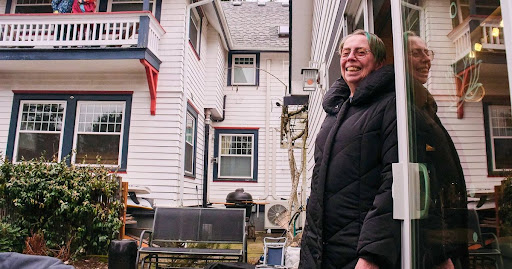
So, the family looked into building one. The parents now live in the main house and the adult children in the ADU — in this case, a once-decrepit garage transformed into a 400-square-foot studio with a kitchen and bath.
The arrangement makes it simple to share meals, planned or spontaneous, and to pick up items for the other household at Trader Joe’s. “I love having them around,” Szudy said.
“It made total sense,” she said. “The idea of having a family compound, being close but having separate spaces.”
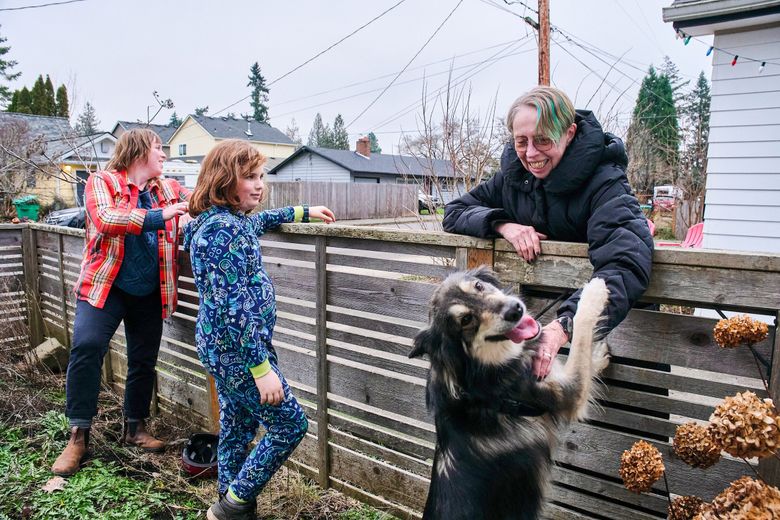
In Portland, Oregon, on the other hand, it’s the younger family — Jules Radkin and Pia da Silva, their two children and a dog — who occupy the primary four-bedroom house. Da Silva’s parents moved into the ADU, a 740-square-foot, two-bedroom structure also converted from a garage.
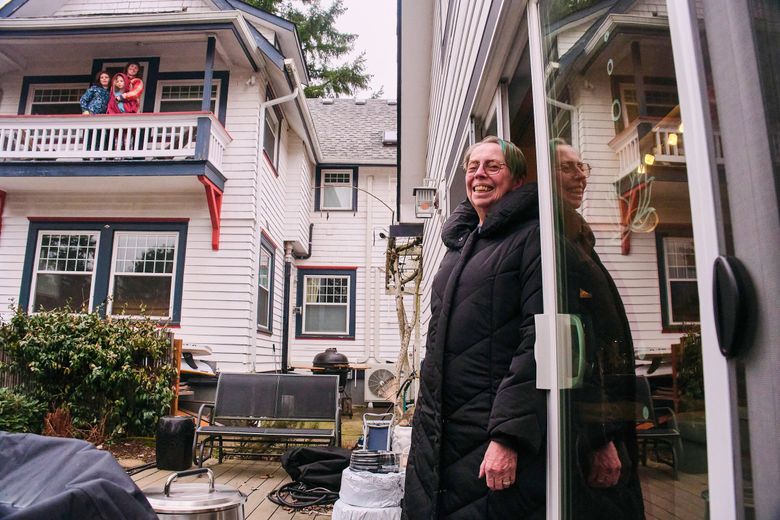
Vona da Silva and her husband, Richard Silva, da Silva’s parents, had been planning to age in place in a downtown condo. But with their daughter’s expanding family outgrowing their small house, the older couple sold their condo. In 2014, they bought the property both families now share, designing and building their backyard ADU with plenty of grab bars. Since Silva died last year at 83, Vona da Silva, 80, has lived there alone.
“It absolutely exceeded all our expectations,” she said of the arrangement. With the children so close, “if they need child care, I pitch in. If I need care in the future, they will pitch in. They are prepared to be caregivers.”
Accessory dwelling units — also known as in-law suites, granny flats, casitas or guest cottages — come in many forms. They can be free-standing or attached to the main house on the property they share; they can be apartments in basements or atop garages. An ADU, which is typically 600 to 1,000 square feet, has a bathroom, a kitchen or kitchenette, and, usually, a separate entrance.
Its function can change over the decades. A rental that generates income for young homeowners might later become a refuge for returning young adults, then become a way for older homeowners to defray housing costs and remain in their neighborhoods.
In an aging nation, an ADU makes particular sense for people in their 60s and up who don’t want to move and will need nearby caregivers, either family members or hired aides. Silva died at home of pulmonary fibrosis, and in his final weeks and months, his daughter and son-in-law had to walk only a few yards to help care for him.
“They came over and did whatever needed to be done,” Vona da Silva said. With such proximity, “everybody has to be respectful,” she acknowledged. “But for us, it’s been wonderful.”
As affordable housing grows increasingly scarce for both young and old, ADUs provide several advantages. “They create housing that doesn’t alter the look or feel of a community,” said Zoe Baldwin, the New Jersey director of the Regional Plan Association, a nonprofit group in the Northeast.
“It’s a way to add capacity within the existing footprint,” she said, a strategy planners sometimes call “gentle density.” ADUs don’t require much government investment in infrastructure, and they reduce energy consumption and costs.
Accordingly, they are growing more popular. Ten states and the District of Columbia, as well as many municipalities, have adopted or revised laws to encourage ADU construction, reducing barriers like zoning, parking restrictions and onerous approval processes.
In 2019, Seattle loosened restrictions on ADUs in all neighborhoods, leading to a spike in construction of new backyard cottages. Washington state lawmakers this year are considering several bills that would allow more ADUs as well as a proposal to offer property tax breaks for ADUs rented to people with low incomes.
In California, which has passed a series of laws enabling the use of ADUs, permits rose to nearly 20,000 in 2021 from about 1,200 in 2016, the year before the first law took effect, the state has reported.
AARP, which supports ADUs, has helped 17 cities pass such legislation in the past two years, among them Pittsburgh; Denver; Louisville, Kentucky; Raleigh, North Carolina; and Kansas City, Missouri. “It’s encouraging to see the numbers growing,” said Rodney Harrell, the organization’s housing expert.