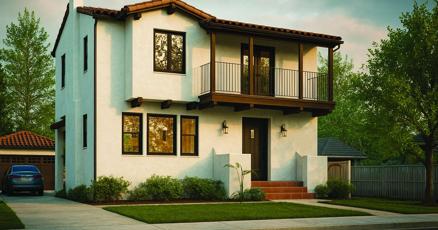
As Altadena continues to rebuild after the Eaton Fire, some homeowners are choosing to use the process as an opportunity to rethink what their properties can provide, including adding accessory dwelling units, or ADUs.
Genesis Builders, which is working with Eaton Fire survivors on home reconstruction, said nearly 65% of its clients are choosing to include an ADU in their rebuilding plans.
An ADU is a separate living unit on the same property as a primary home. Depending on the design, it can serve as housing for family members, a rental unit, home office or other personal space.
Genesis Builders has 16 active home construction projects underway, along with 24 additional clients currently in the preconstruction or permitting phases, according to principal Devang Shah. Homeowners who have reached these stages have already determined whether to incorporate an accessory dwelling unit into their building plans.
The interest, Shah said, has been strong since the company began offering the option. Genesis designed several ADU configurations to accompany its home designs, including a 528-square-foot, one-bedroom unit; an 800-square-foot, two-bedroom unit; and a two-bedroom unit above a garage.
For homeowners, the reasons for adding one vary.
Some see an ADU as a way to generate rental income and offset housing costs. Others are thinking about aging in place or creating space for parents and other relatives. Some homeowners also see the additional unit as a way to increase the long term value and flexibility of their property.
Shah said about half of Genesis’ clients come into the process already interested in an ADU, while the other half become interested after seeing how one could fit on their property and reviewing the cost.
Genesis’ published prices start at about $190,000 for its smallest freestanding ADU, while an 800-square-foot freestanding unit starts at about $223,900. A two-bedroom unit above a garage starts at about $233,900, according to Shah.
Building an ADU alongside the primary home can also be considerably less expensive than adding one later. Shah estimated that homeowners could spend roughly $100,000 to $125,000 more if they wait until after the main home is completed.
That difference comes partly from construction logistics. Crews can build the main home and ADU during the same mobilization, while utilities can be planned and installed together rather than requiring workers to return later for additional trenching and connections.
For some homeowners, the ADU is also about preparing for the future.
Shah recalled one client, a woman in her late 70s, who initially planned to rebuild her home with a detached garage. After discussing her future mobility and the possibility of aging on her own, she decided to add an ADU. The smaller space could eventually allow her to live more comfortably while renting the main house, providing both a housing option and financial security.
Other homeowners are finding more individualized uses. One client plans to turn an ADU into a music studio with additional soundproofing, while others are considering the units as separate home offices.
But the ADU trend comes amid a much larger rebuilding challenge. Shah said that roughly 17 to 18 months after the fire, thousands of destroyed homes have yet to move forward with reconstruction, while some homeowners who have begun planning still don’t know what their final construction costs will be.
For Shah, the rebuilding process is ultimately about more than construction.
“The fight of the human spirit,” he said, is what gives him hope. He described families planning to return home for their children’s graduations and other milestones, saying those conversations have made the work personally meaningful.