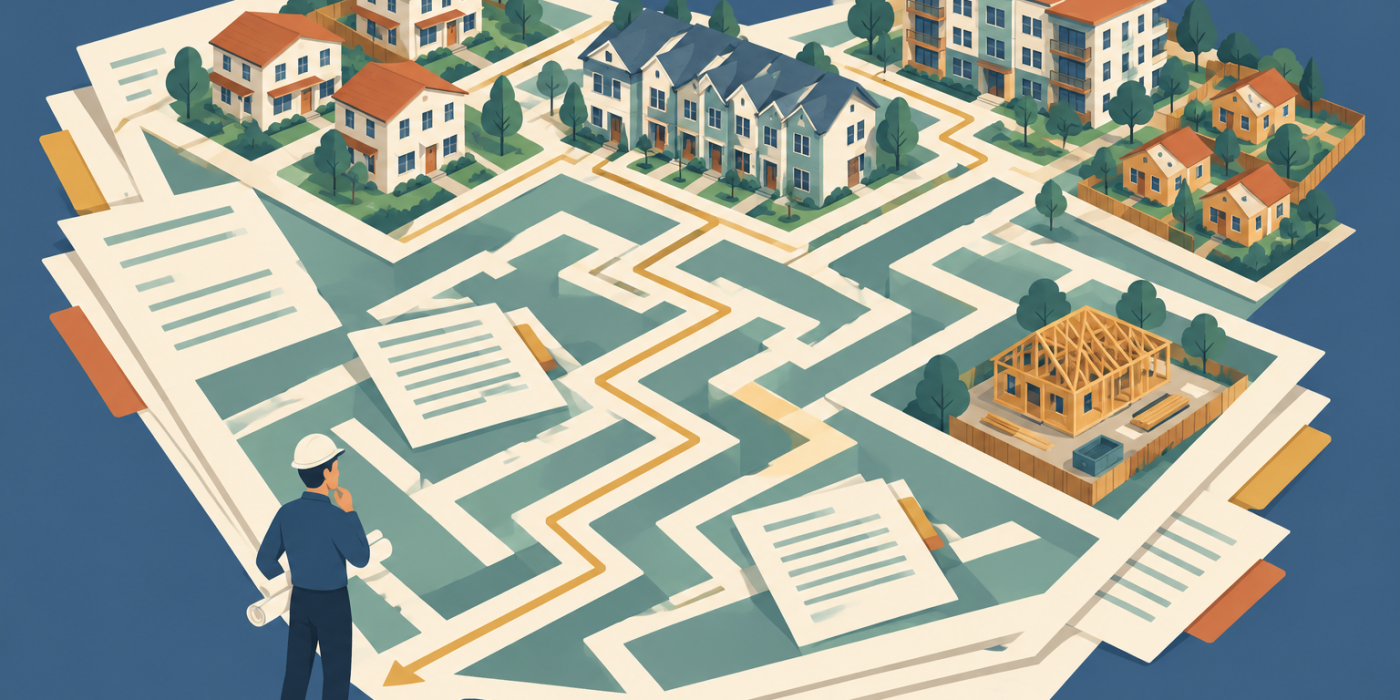
Both signal that the bills have produced mostly positive results. Still, even experienced developers say the pace of change is hard to stay current with.
“We try to keep up, but we also get confused,” AJ Puthanpurayil, principal and managing partner at Los Angeles-based Dreamwork Development, said in an interview with HousingWire TBD. “The same law will have a different name after a few months because they will revise something on it.”
Puthanpurayil keeps building. Dreamwork has several small projects in the pipeline and completed others, taking advantage of different laws.
Trenton Klatte, CEO and cofounder of West End Construction, told HousingWire TBD that Senate Bill 1123 is “creating the most amount of density in most projects that we’ve seen for those kinds of subdivisions.”
That law is the second iteration of the Starter Home Revitalization Act passed in 2021 as Assembly Bill 803.
The legislative maze
The original version of AB 803 allowed subdivision of property in multifamily zoned areas into smaller lots for single-family homes without ministerial approval.
The first change in 2023 (SB 684) permitted up to 10 homes on a site without a hearing. An existing building can stay on its own parcel while up to 10 new homes go on the rest of the lot. SB 1123 passed in 2024 and expanded existing law to vacant single-family lots.
The latest version, SB 1116, signed by Gov. Gavin Newsom last month along with other housing bills, expands eligible sites and limits local standards. It takes effect Jan. 1.
In addition to the Starter Home Act and its iterations, builders have SB 1211, SB 9 and AB 1033.
SB 1211 allows up to eight detached backyard accessory dwelling units on lots with existing apartments, capped at the number of existing units. AB 1033, passed in 2023, lets cities allow backyard units to be sold as condos.
This year, Newsom also signed a new law, AB 1751, the Missing Middle Townhome Ownership Act. It requires local governments to approve subdivision maps for qualifying townhome projects.
SB 9 allows a single-family lot to be split in two, with up to two homes on each. This one hasn’t been as productive as originally billed.
Roi Omer, owner of Valley Boutique Builders, told HousingWire TBD that someone must have the available land and the money to split lots. A property owner can save on zoning and pre-construction work under SB 9.
“But most people who subdivide into two different lots have all the burden of building two new construction homes,” Omer said. “It’s not cheap.”
The solution may not be on the legislative side, though. He said the shortfall is with lenders who are still getting accustomed to the law. The higher interest environment tends to stack the odds against such projects.
The backyard unit boom
The current wave of small-home laws has roots in backyard units.
The boom started in 2016 with SB 1069 and its companion, AB 2299. Then-Gov. Jerry Brown signed both, and they took effect in 2017. The laws required cities to allow accessory dwelling units on most residential lots, reduced parking requirements and limited discretionary review. Local ordinances that conflicted with state law became “null and void.”
Detached units could be as large as 1,200 square feet, a size comparable to a small house. The state was legalizing small homes, not only converted garages and granny flats.
Permitting took off. Statewide ADU permits climbed from just over 1,000 in 2016 to more than 35,000 in 2023, or about 22% of new housing permits, according to a Bay Area Council report. Builders lament the lack of recent permitting figures but say anecdotally the numbers remain strong.
Lawmakers have revised the framework repeatedly. A 2019 package (SB 13, AB 68 and AB 881) set a 60-day approval deadline, capped side and rear setbacks at four feet and barred impact fees on units under 750 square feet. It also stopped cities from setting maximum sizes below 850 square feet, or 1,000 square feet for units with more than one bedroom.
The ADU laws helped set the stage for later small-home legislation: statewide standards, limited local review and tight approval deadlines.
Fine line between ADU and small homes
An ADU in one place could be a small home on a different site, depending on the law used. That means a builder specializing in ADUs can take the same design into a cottage court development.
“Very similar construction processes,” Klatte said. “Different entitlement and permitting strategy for the developer to get there.”
Builders are getting creative on properties. California-based BuildCasa completed a townhome infill project under the starter home SB 684 version and recently put units on the market, including a 797-square-foot two-bedroom, two-bathroom unit for $675,000. Paul Steidl, co-founder of the firm, posted on LinkedIn that the existing home sold earlier this year.
In Hawthorne, next to Los Angeles International Airport, Puthanpurayil’s firm has six townhomes rising under SB 684. It has seven townhomes and four ADUs replacing an abandoned building elsewhere in the city. It also bought a church’s closed school and is replacing it with 10 three-story townhomes, with 10 ADUs on the first floor.
“We look at the maximum density we can do on the lot, and what makes sense for us numbers-wise,” Puthanpurayil said. “We were able to pick it up for about $1 million.”
Klatte said ADUs became the hottest item for investors and homeowners looking to add square footage and predicted a similar path for starter homes.
“It’ll be very prevalent throughout Southern California moving forward,” he said.