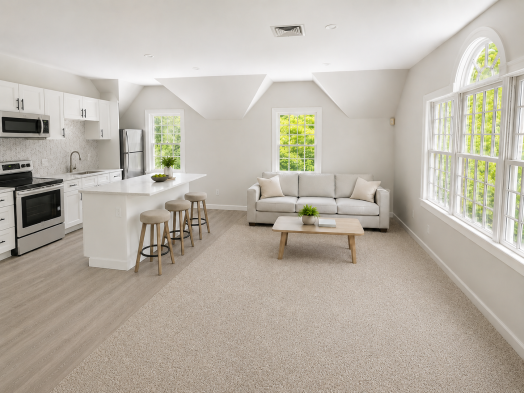
Accessory dwelling units arrived in Massachusetts in 2025, but Wellesley has been ahead of the curve since 2022. The affluent Boston suburb has seen a modest, steady uptick in ADU permit applications — three filed in 2025 alone — and advocates say the units could play a meaningful role in addressing what one housing affordability group calls a “harrowing housing shortage” in one of the state’s most expensive communities.
Andrew Mikula of Building a Better Wellesley argues that ADUs are uniquely suited to Wellesley’s housing problem precisely because they don’t require a developer, a rezoning fight, or a neighborhood battle over a new apartment building. They’re initiated by individual homeowners responding to specific needs — a parent moving closer, a college graduate returning home, a tenant to offset a mortgage. “You’re connecting very directly to the demand for housing,” Mikula said.
ADUs also allow communities to grow incrementally rather than through large-scale development. Mikula sees them as a natural fit for seniors looking to downsize on their own property, for young adults seeking a first independent living situation, and for families who want a foothold in Wellesley before buying a home outright.
Massachusetts legalized ADUs statewide in early 2025, and Wellesley updated its bylaws in April of that year to align with the new law. The changes removed an owner-occupancy requirement and eliminated the special permit previously required for detached units — two barriers that had historically limited uptake. But Mikula says the town still has work to do. ADU regulations on the town’s website remain difficult to parse, and outreach to the homeowners most likely to benefit — longtime residents who may not know what’s now available to them — has been limited. He’d like to see information distributed through the public library and the Council on Aging, venues that reach exactly the demographic most likely to act.
The experience of Yardena and Joshua Katz illustrates both the appeal and the friction. The couple, who applied for an ADU permit in July 2025, came to Wellesley from California, where Joshua said ADUs were “ubiquitous.” They planned to convert existing space and eventually rent to a student or faculty member at one of the town’s colleges. The project turned out to be slower and more expensive than expected. At one point, the town required them to install electric vehicle charging infrastructure despite the fact that neither the Katzes nor any prospective tenant would be using the garage for parking. The requirement was eventually resolved through direct conversation with town officials, but it illustrates a broader challenge: Wellesley’s ADU rules are new enough that even the people administering them are still working out how to apply them.
“Building is challenging enough when the rules are clear and well established,” Joshua said. “It just becomes a lot more cumbersome and onerous when things are new and opaque and evolving.”
His practical advice for homeowners considering an ADU: find professionals who can communicate directly with town officials before construction begins, and plan for the process to take longer than expected.