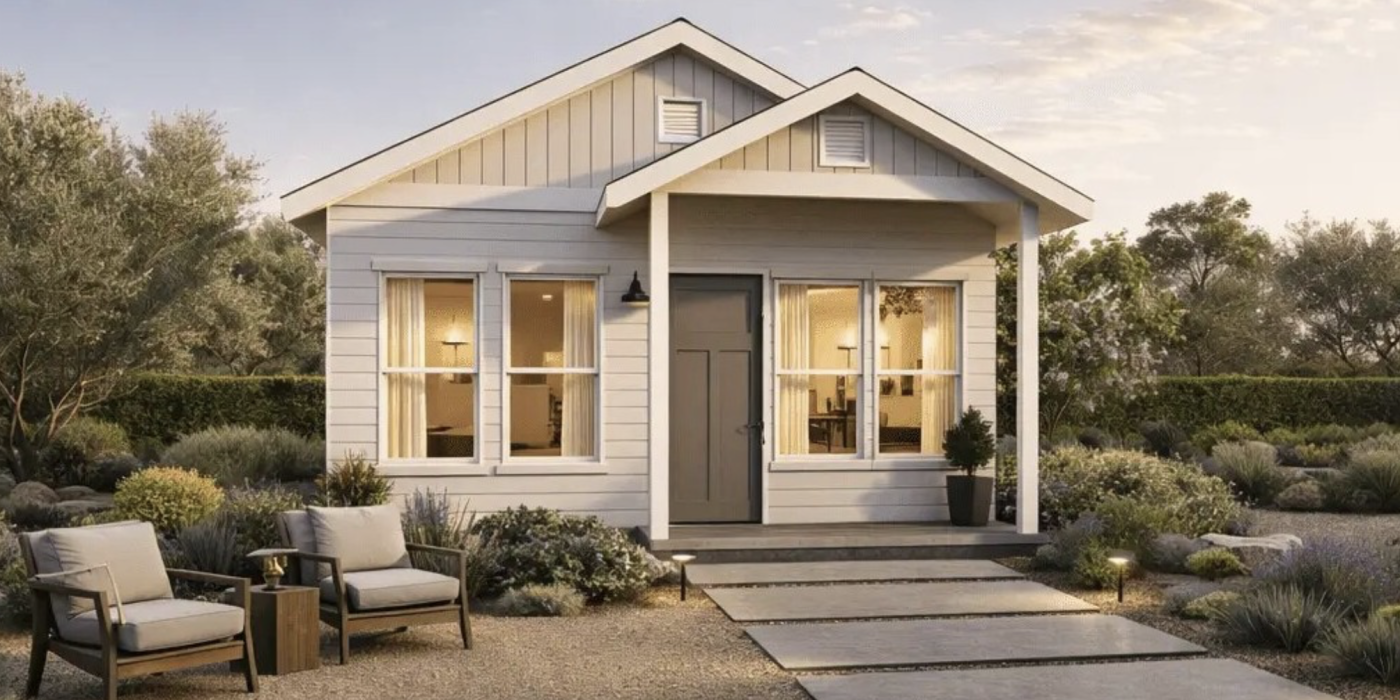
Some view ADUs as an ideal housing solution, while others see them as a catalyst for new community challenges.
THE BACKSTORY: CALIFORNIA’S PUSH FOR INFILL HOUSING
California has struggled with a severe housing shortage for decades. The state remains one of the most desirable places to live in the country, leading to a structural imbalance: far more residents than available homes. Historically, local zoning restrictions—specifically single-family zoning that limited lots to one home—served as the primary barrier to housing growth. Impact fees, minimum parking requirements, and lengthy municipal reviews further compounded the issue.
Beginning in 2016, the California Legislature enacted a series of laws that significantly curtailed local municipal restrictions. These statutes eased single-family zoning, eliminated select developer fees, and streamlined the permit review process. Today, roughly 1 in 5 new residential construction permits issued statewide are for ADUs. Locally, Imkat Construction has built nearly 100 across the Sacramento region, with over 200 in progress.
In 2023, California passed Assembly Bill 1033 (AB 1033), which allows municipalities to permit ADUs to be sold separately as condominiums without requiring a traditional land subdivision. AB 1033 does not mandate that cities allow separate sales; rather, it gives local jurisdictions the option to adopt the framework. Major California cities—including San Jose, Berkeley, San Francisco, and San Diego—have actively adopted or moved to implement AB 1033.
The pioneer San Jose transaction represented a win-win scenario for the seller, the buyer, and the city.
“We’re unlocking homeownership opportunities at lower price points, one ADU at a time,” said San Jose Mayor Matt Mahan. “We’re not waiting for costs to come down — we’re using innovative policies to create affordability wherever we can.”
While $530,000 for a 749-square-foot home may sound steep in other regions, it represents a substantial entry point for San Jose, where median single-family home prices exceed $1.4 million. The core benefits of this policy shift include lowered barriers to homeownership, immediate additions to housing inventory without large-scale developments, and multi-generational living or income-generating opportunities for existing property owners.
COMMUNITY IMPACT AND CHALLENGES
Despite the benefits of AB 1033 and expanded ADU laws, several operational and neighborhood challenges remain:
Infrastructure and Neighborhood Constraints: Local officials frequently receive feedback regarding street parking, traffic volume, school capacity, and shifting neighborhood aesthetics. Under state preemptions, municipal enforcement power is limited. For example, cities cannot levy impact fees on ADUs under 750 square feet, nor can they mandate off-street parking if the ADU is within a half-mile of public transit or converted from existing structure space.
Institutional Investor Interest: Community groups express concern that real estate investors may acquire single-family lots specifically to build and monetize ADU units as rental portfolios, bypassing local review.
Privacy and Proximity: Setback reductions mean new structures can be built closer to property lines, occasionally leading to privacy disputes between neighboring homeowners.
Valuation and Financing Hurdles: Mortgage lenders and real estate appraisers face difficulty establishing accurate property values for condominiumized ADUs due to a historical scarcity of comparable sales data (“comps”).
FOOD FOR THOUGHT
Have you considered adding an ADU to your primary residential property for sale, rental income, or family use?
How would the construction of an ADU on an adjacent lot impact your perspective on local neighborhood density?
Does the broader benefit of increased housing supply outweigh local density and infrastructure concerns?
THE BOTTOM LINE
ADUs represent a permanent shift in California’s real estate landscape. Whether viewed as an innovative solution to supply shortages or a source of municipal friction, ADUs offer versatile path choices for property owners. Options range from custom builds by local architects and general contractors to factory-built, manufactured units from companies like Boxabl.
For property owners with available land seeking rental yields, flexible family arrangements, or equity creation, ADUs present an intriguing asset strategy.
From my viewpoint, ADUs will generally cause more good than harm. While some will resent changes to their neighborhoods, others will see them as a new revenue stream, or a way for family to stay together.
One thing’s for certain: ADUs are here to stay.
FREQUENTLY ASKED QUESTIONS (FAQ)
WHAT IS AN ADU (ACCESSORY DWELLING UNIT)?
An Accessory Dwelling Unit (ADU) is a self-contained residential unit located on the same lot as a primary single-family home. Commonly referred to as granny flats, in-law suites, casitas, or backyard cottages, an ADU must include permanent provisions for living, sleeping, eating, cooking (a full kitchen), a bathroom, and an independent exterior entrance.
The primary classifications of ADUs include:
- Detached ADU: A standalone residential structure physically separated from the primary dwelling.
- Attached ADU: An extension added directly to the exterior wall or second story of the existing home.
- Conversion ADU: Space created by transforming existing non-living areas, such as an attached or detached garage, basement, or attic.
- Junior ADU (JADU): A distinct statutory category under California law capped at a maximum of 500 square feet. JADUs must be constructed entirely within the walls of an existing primary residence or attached garage and are permitted to share sanitation facilities with the primary structure.
HOW MUCH DOES IT COST TO BUILD AN ADU IN CALIFORNIA?
Construction costs vary based on square footage, site grading, utility connection distance, finish quality, and structural approach:
- Garage or Space Conversions: Generally the most cost-effective approach ($80,000 to $120,000) due to utilizing existing foundations and framing.
- Prefabricated / Modular ADUs: A mid-range option manufactured off-site and delivered for rapid installation. For example, Boxabl’s 361-square-foot “Casita Studio” model offers turn-key pricing options starting near $150,000 including delivery and site setup (pricing should be verified directly with manufacturers for current site-specific quotes).
- Detached Custom Ground-Up Builds: Ground-up stick-built structures generally range between $125,000 and $400,000+ depending on local labor rates and utility requirements. Companies like Imkat Construction have over a dozen fully customizable models to choose from, starting in the low $100,000’s.
CAN A HOMEOWNERS ASSOCIATION (HOA) PROHIBIT ADU CONSTRUCTION?
No. Under California law (Civil Code § 4751), Homeowners Associations (HOAs) cannot prohibit or unreasonably restrict the construction or use of an ADU or JADU on a single-family lot. However, HOAs retain the authority to enforce reasonable design guidelines, such as architectural color matching, height parameters, and safety standards, provided they do not unreasonably increase the cost or delay construction.
Note: Real estate legislation, municipal codes, and vendor pricing are subject to periodic updates. Always perform due diligence and consult local planning authorities prior to initiating a construction project.
WHERE CAN I FIND CALIFORNIA ADU BUILDING GUIDELINES AND ZONING RULES?
The primary regulatory resource is the California Department of Housing and Community Development (HCD). The HCD provides an updated Statewide ADU Handbook detailing statutory baseline requirements. Property owners should cross-reference state guidelines with local city or county planning departments to review municipal-specific setbacks, height limits, and design standards.