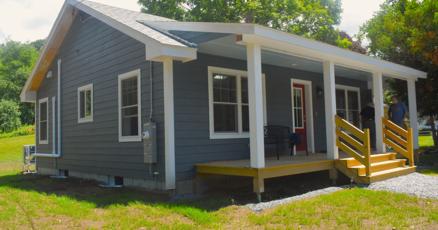
Berkshire County municipalities have reported approving 16 accessory dwelling units since a state law made them easier to build 18 months ago, according to state data.
The county’s approvals represent less than 1 percent of the 2,084 reported statewide. That is nearly in line with Berkshire County’s 1.8 percent share of the state population, although its rural character, limited public water and sewer infrastructure, and lower housing density complicate a direct comparison.
Massachusetts has introduced three programs intended to encourage ADU construction, but local officials and homeowners say the cost of building the units remains a significant obstacle in the Berkshires.
ADUs are “a good way to encourage density where we want there to be density,” said Justine Dodds, Pittsfield’s community development director. “They’re still challenging because they’re expensive to do.”
A state law that took effect in early 2025 allows ADUs by right in single-family zoning districts, provided they comply with reasonable local requirements, including setback rules. During the law’s first six months, Berkshire County municipalities reported receiving only six applications. Experts attributed the slow start largely to high construction costs.
The latest state data show little change. Berkshire County municipalities reported approving 16 ADU permit applications, or 0.77 percent of the 2,084 approvals reported statewide. By comparison, the county accounts for about 1.8 percent of Massachusetts’ population.
The state figures are incomplete. The data come from municipal surveys, and when a community did not respond to the latest survey, the state carried forward its previous total, if one was available. Lee, for example, approved at least one ADU application that is not reflected in the tracker.
Berkshire County saw 16 applications for ADUs approved in the first year and a half the housing unit has been a right statewide. Unique conditions like the lack of public sewer and water infrastructure plus an already high-cost of construction has led to the dearth of applications, local housing officials said. Even allowing for those limitations, Dodds said the principal obstacle remains construction cost.
“Costs are the same statewide, but our property values are lower out here,” she said.
INCENTIVES ON TABLE
Massachusetts has introduced three initiatives intended to reduce some of the expense. The state held an ADU design competition and made the winning plans available for homeowners to use at no charge. It also launched a low-interest loan program offering as much as $250,000 for detached ADUs and a program that subsidizes preconstruction planning.
The planning program, launched this summer, gives homeowners access to professional feasibility studies for no more than $500. The studies examine a property’s physical constraints and local zoning requirements and provide a preliminary high-end cost estimate.
Those programs may reduce financing and planning expenses, but they do not eliminate the cost of permits, site work and construction.
FROM EXPERIENCE
Bill Swindlehurst of Lee contributed thousands of hours of labor to the construction of his ADU, yet the project still cost more than $250,000. Because he began before the state programs became available, he financed the project with a home equity loan carrying a 6.75 percent interest rate — 2 percentage points higher than the rate available through the state program.
Some of the most surprising expenses came before construction began, Swindlehurst said. Permits, architectural plans, environmental testing and an energy-efficiency rating each cost thousands of dollars.
“Spending money without doing anything was rather frustrating,” he said.
Another significant obstacle in Berkshire County is the limited availability of public water and sewer systems.
Swindlehurst was able to extend his home’s water line to the ADU, although he paid nearly $2,000 for a water-use permit. Without access to a public sewer, however, he also had to install an expensive septic system.
Pittsfield has both public water and sewer systems, making it better positioned for ADU construction. The city reported five applications, the most in the county, since the state law took effect. Pittsfield has received another application since the state compiled its data, Building Commissioner Rian Dowd said.
“We have the infrastructure to support it,” Dodds said. “We’re probably uniquely positioned to do that.”
ADUs can also give older residents an opportunity to move into smaller, more accessible homes while making their larger houses available to other families, Dodds said.
“I see that as a way to help free up and increase the supply as well,” she said.
That possibility was one reason Swindlehurst built his ADU. He rents it now, but said he and his wife might eventually move into it.
Swindlehurst said he also valued the possibility of dividing the property so that either residence could be sold separately. But even establishing the property boundaries required a $4,000 survey, he said, illustrating how quickly preliminary costs can accumulate.
“These are the costs — they’re just so high,” he said. “I don’t know how people are expected to build. We’re not rich out here.”